Sunday, 26 February 2017

Rhoodmen of Rutland

A Rutland Rhoodman
This little pottery figure is a Rhoodman. The Rhoodmen of Rutland was the title of a book published in 1982 by Patrick Beese.

The book was an account with humorous illustrations of the history and customs of a mythical race of small people who live on, and around Rutland Water.

Rhoodmen were "the original inhabitants of the ancient kingdom of what we now call Middle England. The small remaining part is now known as Rutland, though the original territory, known as Rhutland, spanned from Wales to the Wash."

I can remember these pottery figures being on sale in a gift shop in Ketton in the mid 1980s but this one I bought in a car boot. It has no maker’s mark.

From Pat’s website, www.rhoodbooks.co.uk
“Pat emigrated to Rutland in 1977, just after the Last Ice Age created the Great Inland Sea known as Rutland Water. He taught Art & Design at Secondary level for ten demoralising years before taking up computer aided design. Computers don’t argue back!"

The "Rhoodmen of Rutland" was later the name of a local scooter club.


Cover of
The Rhoodmen of Rutland (1982)

Monday, 20 February 2017

Goering in Rutland


Goering in 1917; 
he finished the First World War
as an ace with 22 victories. 
A Rutland tale is that Hermann Goering, leading Nazi and First World War ace, had lived in South Luffenham as a young man and scratched his name or initials on a window (either the windowsill or a pane of glass) in the Rectory.

A related story that I heard as a boy is that in the Second World War, Goering had intended Burghley House to be his residence after a successful German invasion and that his Luftwaffe were ordered not to bomb the Elizabethan mansion.

The earliest written mentions that I have found date from the beginning of the Second World War, e.g. from the Leicester Mercury; Friday 22 September 1939;

"When Goering Lived In Rutland

It is not generally known that Field Marshall Goering, Hitler’s Second-in-Command, once lived at South Luffenham, Oakham. In April, 1914, he went as a pupil to the Rev. J. F. Richards, then rector, presumably to learn English, which, it was later discovered, he could speak like a native.

Mrs Beasley, who still lives in the village, was in service at the Rectory at the time, and she told a reporter that she can well remember him.

He was then tall and gaunt looking – vastly different from the corpulent Goering of to-day. In company he would speak broken English but Mrs Beasley said she often heard speaking to the cat in perfect English.

Left Before The War
“He often used to go ‘sightseeing’ in large towns with the Rector’s son, managing to lose himself and return the next day, but it was queer the way he left the country on July 28, one week before the declaration of war” she said. “It only occurred to us after he had gone that he was a German spy. He was the son of the then German Chancellor of the Exchequer, I believe.”


The named source, Mrs Beasley (apparently Violet Beasley, née Bayliss) and the precision about the dates April to 28th July 1914, makes the newspaper report appear plausible.
St Mary's, South Luffenham 

His tutor was the Reverend John Francis Richards, M.A., rector 1908-30. Richards was a graduate of Balliol College, Oxford and a former Second Master of Lancing College. Balliol College held the advowson - the right to appoint rectors - and Richards was one of a succession of Balliol men to hold the rectory.

Richards certainly did accept pupils; in the 1911 Census, three students (ages 18, 19 and 22) were boarding at the Rectory. In October 1909, an 18-year old student at the Rectory, John William Jones, had accidentally shot dead a 12-year old village boy, David Hudson.

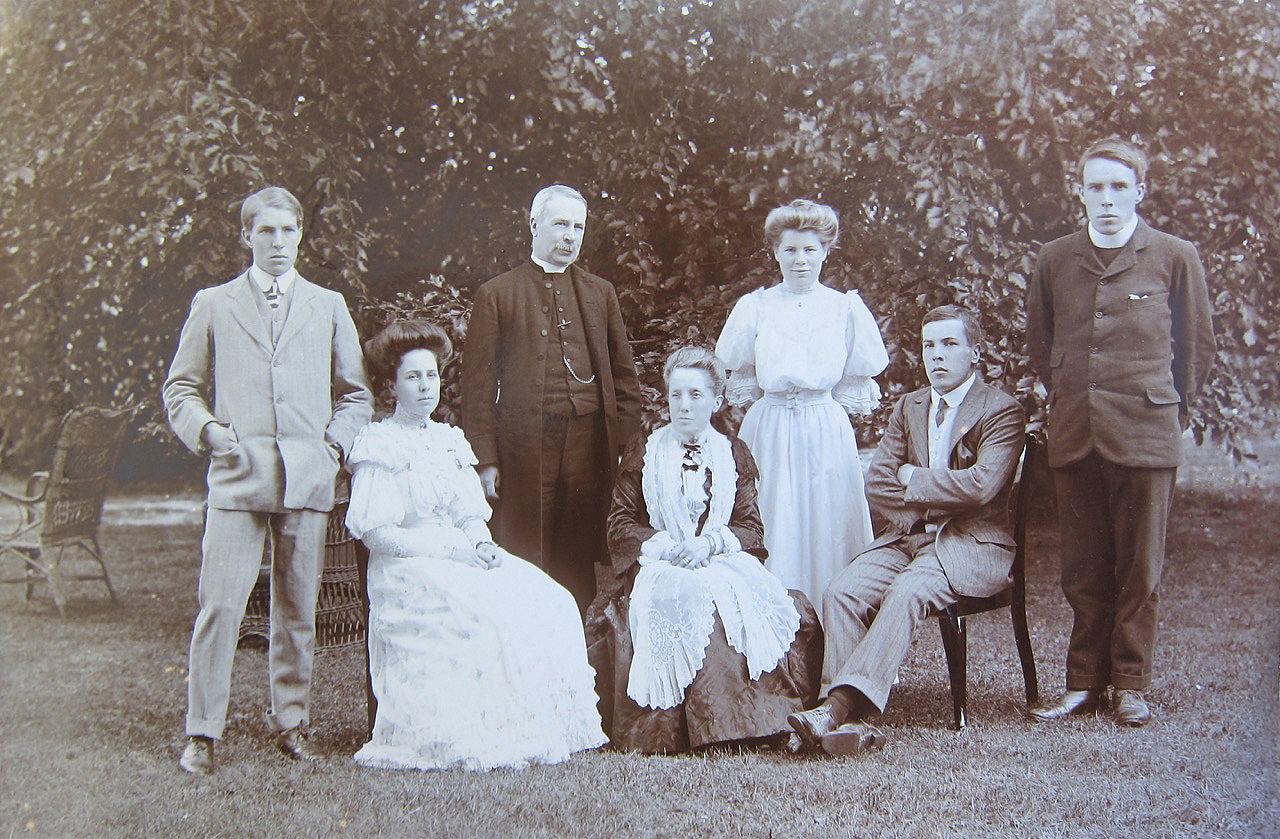
On 25th September 1915, the third son of the rector, Second Lieutenant Julian David Eaton Richards (Sussex Regiment) was killed at Loos. He is commemorated with a plaque in South Luffenham church. The Rutland Remembers website has a photograph of the Richards family in the Rectory gardens in ca 1914.

A problem with the tale is that in 1914 when Goering was supposedly in Rutland he was already serving in the German army. He had graduated from the Prussian Military Academy and joined the 112th (4th Baden) Infantry "Prince William". When the war began in August 1914, Goering was stationed with his regiment at Mühlhausen (Mulhouse), near the border with France.

Burghley House
A further embellishment in the version of the tale told here by the curator of Burghley House, John Culverhouse, is that Goering was accompanied by a son of the Kaiser when he studied nearby. Goering did accumulate a vast collection of plundered art so he might well have fancied Burghley but, again, where is the evidence?