Monday, 9 October 2017

A Stone Palm in Barnack


In the churchyard of Barnack, a large stone monument in the form of a semi-recumbent palm tree marks the grave of George Ayscough Booth, Gentleman Cadet, Royal Military College Sandhurst, who died in 1868, aged 20.

George Ayscough Booth was born in Wiesbaden, capital of the Duchy of Nassau, in Germany on 27th December 1847. He was the only son of the Reverend George Ayscough Booth and Anna Maria Godolphin, the eldest daughter of Admiral John Ayscough. His parents had married in Southampton on 21st October 1843. George was brought back to England to be baptised on 5th February 1847 at Hatfield, Hertfordshire but the family returned to Wiesbaden where twin sisters were born on 12th December 1848.

The cadet's father, the Reverend George Ayscough Booth, a graduate of Exeter College, Oxford, was curate of Barnack, 1856-61, and then held the living of Clandown near Radstock in Somerset, 1861-72. The parents brought their only son’s body back to St John the Baptist, Barnack for burial close to the grave of his infant sister; Nina Jane Carnegie Booth had died, aged five months, in 1858.

Gentleman Cadet George Ayscough Booth had died on 17th April 1868 at Paris, on his way to England from Hyères (on the French Riviera). The cause of death is not reported.

The semi-recumbent palm tree on his memorial can be seen as a symbol of the resurrection; a palm tree bends in a storm so that the top could touch the ground but still spring back upright. The choice of a palm tree might allude to the place he had gone to for the sake of his health. Hyères’ position facing the Mediterranean is ideal for the cultivation of palm trees so the town is referred to as Hyères-les-Palmiers (palmier meaning palm tree). Hyères was popular with English visitors in the winter and Edwin Lee had published in 1857 a book on the virtues of the climate of Hyères for recovery from pulmonary consumption (tuberculosis) which might suggest a possible cause of his death.

A memorial window to George Ayscough Booth was erected in the east end of the Royal Military College Chapel, Sandhurst in 1869. “The stonework of the fifteenth century, by Mr Buckeridge of London, is a richly-cusped four-light window, with elaborate tracery. The two side lights, bearing a series of subjects in stained glass, commemoratively display, under the form of allegory, the virtues of bravery, piety, brotherly love, and resignation, while the Crucifixion, Resurrection, Ascension, and Judgment, are embraced by the centre compartments. Faith, hope, charity, humility, forgiving spirit, and repentance are also allegorically displayed in the tracery and with two angels bearing texts, complete the figurative arrangement, the entire work being perfected by canopy work surmounting each group. It is a very successful work of art, and a great improvement to the chapel. R. B. Edmundson and Son of Manchester, are the artists of the glass work.” (The Bath Chronicle 21st October 1869). The architect, Buckeridge of London, is presumably Charles Buckeridge ARIBA who died 1st September 1873. The glass business, Messrs Edmondson and Son, Angel Street, Manchester was established in 1854 by Ralph Bolton Edmundson who had earlier headed the stained glass section at Pilkingtons.

The stained glass window still exists in what is now the Indian Army Memorial Room at Sandhurst. The chapel of the Royal Military College, Sandhurst, was consecrated in 1813 but it was not large enough when the number of gentlemen cadets rose following the abolition in 1871 of the purchase system for commissions, and it became, successively, a model room, a museum, a cadet dining room, the Indian Army Museum and, in 1970, the Indian Army Memorial Room.

Sandhurst confirms that Cadet George Ayscough Booth joined the college on 1st February 1867 aged 19. The Royal Military Academy holds copies of correspondence between his father, the college and the War Office regarding the intended design of the window, which apparently required the approval of the Commander in Chief, the Duke of Cambridge, who took a personal interest in the project.

The cadet’s mother, Anna Maria Godolphin Booth, died on 25th March 1876 in Bath, aged 59. The widower married Frances Elizabeth, second daughter of Maj-Gen Pickering RA, on 4th August 1881. The Rev. George Ayscough Booth died “very suddenly”, at 54, Pulteney Street, Bath on 17th December 1884, aged 67. The only surviving child of the family, Kathinka Wilhelmina (born 1855 in Germany), married Charles Edward Mackintosh Russell in 1885; she died on 28th December 1932 aged 78.


The monument is in St John the Baptist Churchyard (north east of the church), Barnack, Peterborough Unitary Authority. Barnack is south east of Stamford, Lincolnshire.


Thursday, 16 March 2017

Oakham Rural


1st April was also the date in 1974 of the dissolution of the County of Rutland's four urban and rural district councils: that is, Oakham urban district and Ketton, Oakham, and Uppingham, rural districts. This small plate marks the end of Oakham Rural District and displays the arms of the rural district. The plate does not have a potter’s mark. Oakham Rural District covered northwestern and central parts of Rutland; a separate Oakham Urban District (the parish of Oakham) was formed in 1911.

The Civic Heraldry website gives information on the arms which were granted in 1958 and has a colour illustration.
Arms: Vert semé of Acorns and fretty Or on a Chief Gules a Pegasus courant Argent between two Horseshoes Gold.
Crest: On a Wreath of the Colours upon a Rock Or a Bull Statant Gules armed and unguled Gold.
Motto 'PARVA COMPONERE MAGNIS' - “Small but comparable with great”.

The green and gold colours and the horseshoe and acorns appear on Rutland’s arms and flag. The green and the acorns are indicative of the rich pastures and woodlands and also commemorate the forest which at one time covered much of the County. Acorns also link to the oak in the name of Oakham. The horseshoes refers to the ancient custom that Peers of the Realm passing through the town are required to present a horseshoe to the Lord of the Manor of Oakham and a unique collection of ceremonial horseshoes can be seen in Oakham Castle.
Oakham Rural District shown in red

The other emblems recall three great families associated with Rutland: the Noels (Earls of Gainsborough) of Exton, the Finch family of Burley-on-the-Hill and the Earls of Ancaster of Normanton Hall. The "fretty" comes from the arms of both the Noel and Ancaster families. Pegasus is taken from the arms of the Finch family, but also signifies a link with the Cottesmore Hunt.

The rock on the crest represents quarrying and industry in general, while the bull signifies agriculture, stock rearing being of particular importance in the area.


Sunday, 26 February 2017

Rhoodmen of Rutland

A Rutland Rhoodman
This little pottery figure is a Rhoodman. The Rhoodmen of Rutland was the title of a book published in 1982 by Patrick Beese.

The book was an account with humorous illustrations of the history and customs of a mythical race of small people who live on, and around Rutland Water.

Rhoodmen were "the original inhabitants of the ancient kingdom of what we now call Middle England. The small remaining part is now known as Rutland, though the original territory, known as Rhutland, spanned from Wales to the Wash."

I can remember these pottery figures being on sale in a gift shop in Ketton in the mid 1980s but this one I bought in a car boot. It has no maker’s mark.

From Pat’s website, www.rhoodbooks.co.uk
“Pat emigrated to Rutland in 1977, just after the Last Ice Age created the Great Inland Sea known as Rutland Water. He taught Art & Design at Secondary level for ten demoralising years before taking up computer aided design. Computers don’t argue back!"

The "Rhoodmen of Rutland" was later the name of a local scooter club.


Cover of
The Rhoodmen of Rutland (1982)

Monday, 20 February 2017

Goering in Rutland


Goering in 1917; 
he finished the First World War
as an ace with 22 victories. 
A Rutland tale is that Hermann Goering, leading Nazi and First World War ace, had lived in South Luffenham as a young man and scratched his name or initials on a window (either the windowsill or a pane of glass) in the Rectory.

A related story that I heard as a boy is that in the Second World War, Goering had intended Burghley House to be his residence after a successful German invasion and that his Luftwaffe were ordered not to bomb the Elizabethan mansion.

The earliest written mentions that I have found date from the beginning of the Second World War, e.g. from the Leicester Mercury; Friday 22 September 1939;

"When Goering Lived In Rutland

It is not generally known that Field Marshall Goering, Hitler’s Second-in-Command, once lived at South Luffenham, Oakham. In April, 1914, he went as a pupil to the Rev. J. F. Richards, then rector, presumably to learn English, which, it was later discovered, he could speak like a native.

Mrs Beasley, who still lives in the village, was in service at the Rectory at the time, and she told a reporter that she can well remember him.

He was then tall and gaunt looking – vastly different from the corpulent Goering of to-day. In company he would speak broken English but Mrs Beasley said she often heard speaking to the cat in perfect English.

Left Before The War
“He often used to go ‘sightseeing’ in large towns with the Rector’s son, managing to lose himself and return the next day, but it was queer the way he left the country on July 28, one week before the declaration of war” she said. “It only occurred to us after he had gone that he was a German spy. He was the son of the then German Chancellor of the Exchequer, I believe.”


The named source, Mrs Beasley (apparently Violet Beasley, née Bayliss) and the precision about the dates April to 28th July 1914, makes the newspaper report appear plausible.
St Mary's, South Luffenham 

His tutor was the Reverend John Francis Richards, M.A., rector 1908-30. Richards was a graduate of Balliol College, Oxford and a former Second Master of Lancing College. Balliol College held the advowson - the right to appoint rectors - and Richards was one of a succession of Balliol men to hold the rectory.

Richards certainly did accept pupils; in the 1911 Census, three students (ages 18, 19 and 22) were boarding at the Rectory. In October 1909, an 18-year old student at the Rectory, John William Jones, had accidentally shot dead a 12-year old village boy, David Hudson.

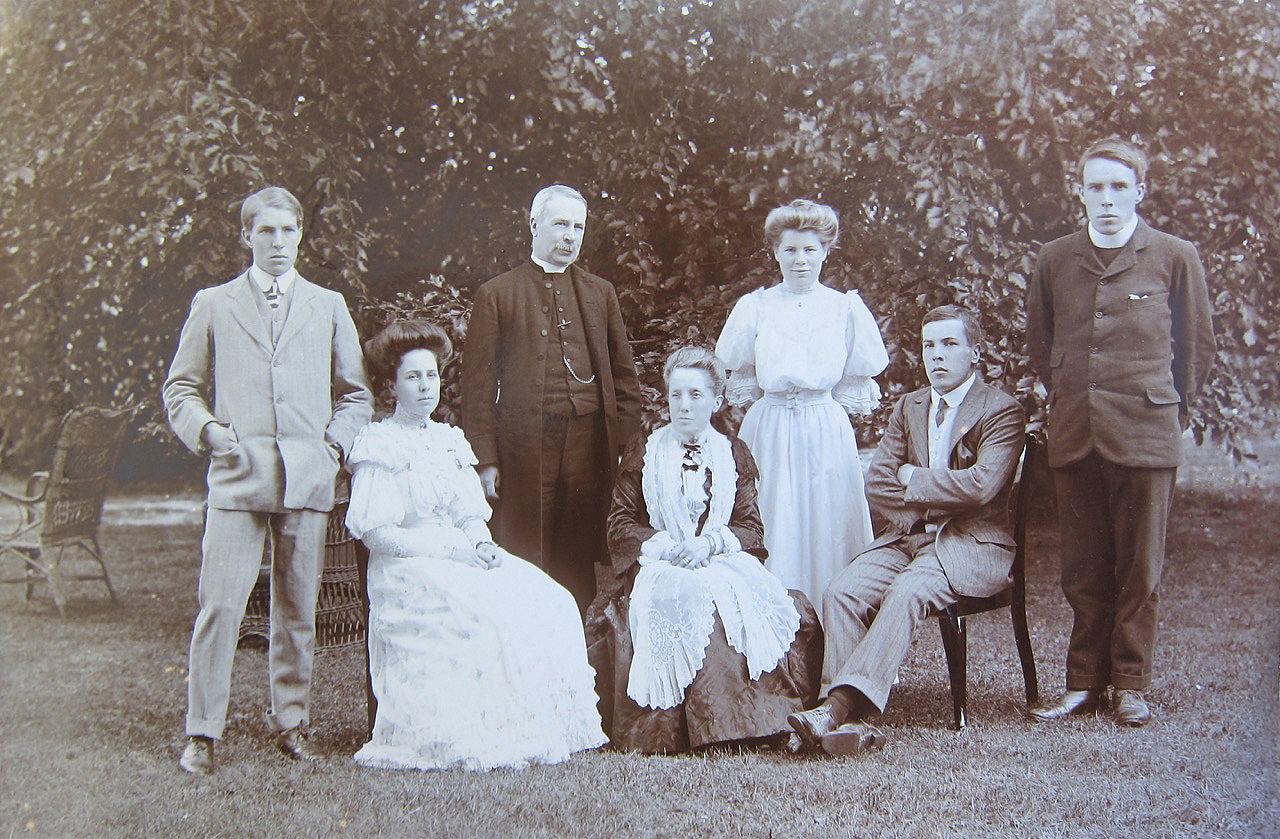
On 25th September 1915, the third son of the rector, Second Lieutenant Julian David Eaton Richards (Sussex Regiment) was killed at Loos. He is commemorated with a plaque in South Luffenham church. The Rutland Remembers website has a photograph of the Richards family in the Rectory gardens in ca 1914.

A problem with the tale is that in 1914 when Goering was supposedly in Rutland he was already serving in the German army. He had graduated from the Prussian Military Academy and joined the 112th (4th Baden) Infantry "Prince William". When the war began in August 1914, Goering was stationed with his regiment at Mühlhausen (Mulhouse), near the border with France.

Burghley House
A further embellishment in the version of the tale told here by the curator of Burghley House, John Culverhouse, is that Goering was accompanied by a son of the Kaiser when he studied nearby. Goering did accumulate a vast collection of plundered art so he might well have fancied Burghley but, again, where is the evidence?